Third brake lamp featuring LED technology | | |
Three-stage Electronic Stability Program ESP®[3] The 3-stage Electronic Stability Program (ESP®) allows the driver to adapt the ESP® to the respective driving style depending on the situation. It reduces the vehicle's risk of skidding and thereby increases driving safety. Three individual control strategies are available: With the ESP® switch the driver can choose between the stages "ESP ON", "ESP SPORT Handling Mode" and "ESP OFF".
| |
Three-point AMG safety belts, silver[10] | | |
ADAPTIVE BRAKE with HOLD function, dry braking in the wet and Hill-Start assist The standard-fit ADAPTIVE BRAKE system improves ride comfort and safety by helping to perform critical braking manoeuvres more safely with the basic function of the ABS anti-lock braking system, while convenience functions support the driver in everyday driving situations. - Supportive HOLD function: the ADAPTIVE BRAKE system's HOLD function, which is activated by briefly depressing the brake pedal, prevents unintentional rolling when stopped at a traffic light or in stop-and-go traffic.
- Extra help: The Hill-Start Assist function prevents the vehicle from rolling back unexpectedly on inclines when moving from the brake to the accelerator pedal.
- Braking effect with no delay: The "brake drying" function removes the film of water that forms on the brake discs in wet conditions.
- For an even quicker response: With the "Priming" option, contact between the brake pads and the brake discs is established as soon as the driver takes his foot off the accelerator quickly.
| |
Adaptive brake lights, flashing Improved perceptual safety and shortened reaction times for drivers following behind: The adaptive brake lights can make a significant contribution to preventing rear-end collisions by indicating an emergency stop to following traffic. If the driver brakes or makes an emergency stop from a speed greater than 50 km/h, the brake lights flash in order to warn following traffic. If the vehicle comes to a stop from a speed greater than 70 km/h, the hazard warning lamps are switched on automatically. | |
Airbags for driver and front passenger The airbags for the driver and front passenger provide protection for the head and torso in a collision, and also afford additional stability to the entire body. They are thus able to mitigate the severity of injuries sustained in an accident. The airbags are deployed when the crash sensors detect an impact of sufficient force. The gas generators of both airbags work in two stages. Both stages are activated depending, amongst other factors, on the detected deceleration force. Depending on the predicted severity of the impact, the first stage of the gas generator is initially activated and the airbag only partially inflated. If a higher severity of impact is predicted, the second stage of the gas generator is activated after a slight delay and the airbag is completely filled. | |
The active bonnet can reduce the risk of injury to pedestrians and cyclists. If the system registers a collision, the rear section of the bonnet rises up by approximately five centimetres using a pyrotechnical propellant. This produces additional deformation space to absorb the impact of the upper body of the affected person sooner. | |
Anti-lock braking system (ABS) The anti-lock braking system (ABS) enhances driving safety, especially when braking for hazards. When braking hard, ABS prevents the individual wheels from locking by modulating the braking pressure of the individual wheels. This ensures that the vehicle remains directionally stable and steerable while maintaining maximum braking power. In other words: ABS allows the driver to brake and steer simultaneously – allowing precise evasive manoeuvring – in order to avoid an accident | |
Acceleration skid control (ASR) Acceleration skid control (ASR) ensures that the wheels do not spin when accelerating. Especially when moving off on snow, ice and gravel, acceleration skid control prevents individual wheels from spinning and the vehicle from fishtailing. The system uses speed sensors to monitor wheel slip. If the system senses a wheel is starting to spin, acceleration skid control corrects the wheel speed by braking and intervening in the engine management system, thus reducing wheel slip. | |
The ATTENTION ASSIST function is particularly helpful on long journeys and when driving at night. The system warns the driver if it detects signs of inattention and increasing fatigue. At speeds of between 80 and 180 km/h, ATTENTION ASSIST warns the driver visually and audibly as soon as it registers any signs of fatigue or inattention. The background: sensors analyse driving behaviour and can detect any changes compared with the previously determined individual driver profile. | |
Outside temperature display | | |
BAS Brake Assist system, brake force boost in the event of detected emergency stops Brake Assist (BAS) can protect against the risk of accidents. The system can recognise emergency braking from the speed at which the braking pedal is depressed and supply full braking power automatically. The anti-lock braking system (ABS) then meters the braking power up to the slip threshold, which is how steering control is maintained. Once the driver releases the brake pedal, automatic brake boosting is immediately terminated. | |
Brake pad wear indicator warning lamp for front axle brakes | | |
COLLISION PREVENTION ASSIST Too small of a gap between vehicles is one of the main causes of severe accidents. The radar-based collision warning system COLLISION PREVENTION ASSIST can enhance safety and driving comfort by warning the driver of following too closely and can support the driver's braking when it detects danger.
The system can recognise insufficient spacing between the own vehicle and objects travelling in front at speeds between 7 and 250 km/h. When the system detects the danger of a rear-end collision it can issue a visual and acoustic warning to the driver.
If the system detects a danger and the driver applies the brakes at the same time, Adaptive Brake Assist can intervene for good measure: It then provides precisely the right amount of brake pressure that is needed ideally to avoid an impending collision. COLLISION PREVENTION ASSIST is an innovative component of the Integral Safety Concept of Mercedes-Benz. | |
| | |
Electronic Stability Program ESP®[8] In critical situations, the Electronic Stability Program (ESP®) can help to stabilise the vehicle by applying a braking force to individual wheels, and adjusting engine performance. By carrying out targeted braking interventions at individual wheels ESP® can prevent both over- and understeer, thus enhancing handling safety. If the ESP® system detects a critical situation, it applies the brakes systematically to one or more wheels according to the situation. Should the system consider it necessary, it will also make an automatic adjustment to engine torque. In this way ESP® helps the driver to stabilise the vehicle within the laws of physics – particularly when cornering and during sudden evasive manoeuvres.
- Central feature: The yaw-rate sensor continuously monitors vehicle movement around its vertical axis and compares the actual values measured with the optimum desired value based on the driver's steering movements and the vehicle's speed. As soon as the vehicle deviates from the ideal line, ESP® intervenes by working to counteract any swerving movements as they occur.
- All the traction all the time: the integrated ASR traction control system additionally controls wheel slip during acceleration with interventions in the engine management system.
- Enhanced safety: ABS as an integral component of ESP® helps to prevent the wheels from locking and to maintain their steering function.
- Dependable basic functions:ESP® consequently supplements the functions of the anti-locking brakes (ABS) and acceleration skid control (ASR) with a driving stability aid.
| |
Headlamp Assist reduces the strain on the driver by automatically switching on low-beam headlamps, tail lamps and number plate illumination when it gets dark outside. The assistance system performs this task even when it's raining or snowing by electronically detecting the cycles of the windscreen wipers. | |
Fluid level warning indicator for fuel, oil, coolant and windscreen washer fluid | | |
Foot-operated parking brake | | |
Belt status indicator in the rear compartment | | |
Tail lights with LED technology The LED tail lamps create an unmistakable night design. All functions are realised with LEDs and to some extent with fibre optics technology. This allows to make LEDs in certain areas of the tail lamp glow at different intensities depending on the light function. The lenses are carried out in red and white. | |
ISOFIX anchorage system in the rear and TopTether securing points on back of rear-seat backrest The ISOFIX child seat attachment points are designed for child seats that use the ISOFIX attachment system. The ease of attachment using this system lowers the risk of incorrect attachment.
A further belt can be attached to the two additional Top Tether attachment points, which prevents the child seat from tipping forward and therefore makes the child seat attachment system even more stable. | |
Childproof locks, manually operated on the rear doors, and electrically for power windows in the rear The childproof locks can be used to prevent the rear doors and windows from being opened. They are set manually for the rear doors and electrically for the power windows. | |
The kneebag installed as standard on the driver’s side helps to protect the legs during impact and also stabilises the entire body. It can thus help mitigate the potential severity of injuries sustained in an accident. If the crash sensors detect a collision of a certain force, the kneebag is deployed. | |
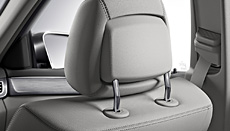
5 adjustable head restraints, crash-responsive NECK-PRO® head restraints in front, 3 height-adjustable head restraints in rear (manual adjustment) The NECK-PRO head restraints for driver and front passenger are activated in a relevant rear-end collision and can reduce the risk of whiplash injuries. They provide head support and reduce the load on the spine at an earlier stage employing a spring mechanism to thrust the head restraints forward and upwards. The restraints can be returned manually to the original position after activation. In the rear compartment three manually height-adjustable and soft padded head restraints provide the necessary comfort. The head restraints for driver and front passenger can be lowered at the push of a button for better visibility during manoeuvring. | |
STEER CONTROL steering assistant The STEER CONTROL assistance system can boost safety by providing corrective intervention in the event of oversteering and braking manoeuvres on unequal road surfaces. The ESP® control unit calculates the additional steering torque required for the respective situation. The electric power assist (EPS) then performs the appropriate steering command. If the vehicle starts to skid, the system can help the driver to countersteer in the right direction with a perceptible pulsation of the steering wheel.
| |
Automatic headlamp range adjustment The headlamp range adjustment adapts the light cones of the headlamps to the vehicle’s pitch (pitch angle). In this way the lighting of the road ahead is always optimal for the driver, and oncoming road users and vehicles travelling ahead are not dazzled. | |
| | |
Pelvisbags for driver and front passenger The pelvisbags for the driver and front passenger provide protection for the pelvic region and hip in a collision. Consequently they can mitigate the severity of injuries sustained in an accident.If the crash sensors detect a relevant side collision, the pelvisbag is deployed. The pelvisbag is deployed in the space between the front-seat occupants’ pelvic region and the door panelling. The pelvisbag then braces itself against the impact area, pushing the occupant’s pelvic region away from the door panelling at a very early stage of the collision. | |
PRE-SAFE® system with reversible belt tensioners for driver and front passenger seats, side window closing function The preventive PRE-SAFE® occupant protection system can recognise critical driving situations and, if necessary, pre-emptively activate reversible safety systems to help reduce the risk of injury to the vehicle occupants. This is based on PRE-SAFE® continuously monitoring sensor data from systems such as BAS and identifying driving situations such as oversteer/understeer and emergency stops.
If a typically critical driving situation is identified by the system, the belt tensioners are activated at lightning speed, the electrically adjustable front-passenger seat (only in conjunction with the Memory package) is moved to a more "favourable" crash position, and the power windows and/or the sliding sunroof or the panoramic sliding sunroof (both optional) are closed automatically. | |
Tyre pressure loss warning system The tyre pressure loss warning system promptly informs the driver of a detected dangerous drop in pressure in individual tyres, which helps to prevent accidents. The system monitors the rotational speed of the individual wheels and can recognise significant losses in pressure depending on any changes. The warning is provided via a display in the instrument cluster. | |
| | |
ASSYST PLUS service interval indicator with service computer | | |
3-point belts incl. manual height adjustment, automatic comfort function, belt force limiters and reversible belt tensioners for driver and front passenger[8] | | |
Sidebags for driver and front passenger The sidebags for driver and front passenger help protect the sides of the body in the event of a side impact and stabilise the entire body in addition. Consequently they can mitigate the severity of injuries sustained in an accident. They are triggered when the central control unit and the side satellite sensors register acceleration or deceleration forces acting on the vehicle in excess of a certain threshold. The sidebags deploy at chest height between the vehicle side and the occupant. | |
Cruise control with SPEEDTRONIC variable speed limiter Relaxed and fatigue-proof driving, increased ride comfort and a fuel-saving driving style made easier: The cruise control function allows the driver to set a desired cruising speed. The integrated variable speed limiter (SPEEDTRONIC) enables the driver to set a desired maximum speed, for example when limits are in force or in 30-km/h zones. The speed limit is selected in increments of one or ten km/h up to the top speed with the control lever, and is displayed in the instrument cluster. If the preset limit is exceeded, e.g. on downhill stretches, the system autonomously shifts the automatic transmission down a gear and applies the brakes to a certain extent. However, if the braking effect is not sufficient, a warning tone alerts the driver that the service brake must also be applied in order to stick to the desired speed limit.
SPEEDTRONIC variable cruise control is an additional function to the familiar cruise control functions and can be activated with a lever. A yellow LED light on the switch and a symbol in the instrument cluster indicate that cruise control mode is turned off and Speed Limit Assist is activated. Speed Limit Assist is switched off by moving the lever back to the cruise control position, by turning it to the "OFF" position or by using the vehicle's kick-down function. | |
TIREFIT with tyre inflation compressor The TIREFIT tyre sealant enables the vehicle to continue driving after suffering a tyre puncture. The sealant is pumped into the flat tyre using an electric air pump, seals holes in the tyre and allows the vehicle to continue on its way to the nearest workshop. | |
First-aid kit in front passenger door | | |
| | |
Warning buzzer and warning indicator in instrument cluster if seat belts are not fastened, parking lamps not switched off or parking brake engaged. | | |
Electronic immobiliser, including locking system with 3-channel radio remote in electronic key with chrome design | | |
In the event of a side impact with a force exceeding a defined threshold (as well as other accidents with the corresponding lateral dynamics), the windowbag deploys to cover the side windows and reduce the risk of a collision between the occupants’ heads and the side of the vehicle or of objects penetrating the vehicle interior. The windowbag is triggered simultaneously with the side- and pelvisbags and always on the side of the vehicle involved in the side impact. Once deployed, the windowbag covers the side panes between the A and C-pillars like a curtain. The window airbag covers a large part of the side when deployed.
The window airbag provides the following advantages: - Protection potential for the head in a side impact
- Technical design and large volume provide excellent protection even for occupants of different stature
- The deployment between A- and C-pillar also protects rear passengers in the outside seats
- Reduces head movement in the event of a direct collision
- Can reduce the intrusion of splinters and other objects
| |
Central locking with interior switch, automatic locking (can be deactivated) and crash sensor with emergency opening The central locking system can increase safety by automatically locking the doors when the vehicle is in motion. The occupants can also exit the vehicle quickly after an accident thanks to the crash sensor with emergency unlocking function. The doors are unlocked when a door is opened or the interior switch for the central locking system is activated. If no doors or the liftgate are opened for 40 seconds after the vehicle has been unlocked via the electronic key, the vehicle will be locked again.
The liftgate is locked automatically when the vehicle exceeds a speed of 3 km/h. The doors are additionally locked when the vehicle exceeds a speed of 15 km/h. If the crash sensor registers an accident, all doors and the liftgate are unlocked to allow outside help to reach the occupants and to let occupants exit the vehicle quickly. | |