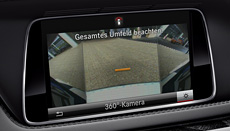
360° camera (optional)[1] The 360-degree camera system displays the vehicle's surroundings from a bird's-eye perspective on the screen of the COMAND Online multimedia system. Monitoring all four sides of the vehicle makes it easier to judge all manoeuvring situations.
The system comprises a short-range camera system with four cameras and a control unit, which together can provide a bird's-eye view of the vehicle and its surroundings One camera is located in a central location in the radiator grille, one in each exterior mirror and one centred in the boot lid. The 'virtual viewpoint' created by the camera images covers an area of about three metres in front of the vehicle and behind. The image is displayed on the head unit screen.
When reversing or parking, additional guide lines, already familiar from the reversing camera function, are displayed to help orientation and the parking manoeuvre. The swept area when turning the wheel is shown along the sides of the vehicle. The camera image changes automatically when the gear is changed (forwards/reversing). The four camera views can also be selected individually through the central controls in the head unit.
| |
DISTRONIC PLUS adaptive cruise control with steering assistant (optional)[2] DISTRONIC PLUS proximity control helps the driver to maintain a specified (timed) distance from the vehicle ahead when travelling at speeds of 0 to 200 km/h. The enhancement with the new STEER CONTROL now also uses lane marking markings for orientation and aids the driver in keeping the lane. Implementing BAS PLUS Brake Assist in conjunction with the PRE-SAFE® brake system helps to avoid rear-end collisions more effectively. If radar sensors identify a potential collision and the driver applies the brakes, BAS PLUS is primed to apply a brake force commensurate to the situation and available stopping distance. In the new E-Class the BAS PLUS function for the first time is expanded to include objects and pedestrians crossing in front of the vehicle, which is of particular relevance in city traffic and at junctions.
If a potential collision hazard is identified at speeds above 30 km/h and the driver fails to apply the brakes in good time, the PRE-SAFE® brake system emits visual and audible warning signals. If the driver also does not respond to this warning, an autonomous partial brake application with a deceleration rate of up to 4m/s2 is triggered approx. 1.6 seconds before the calculated impact. If the system categorises the situation as highly critical and there is no reaction from the driver, an autonomous emergency stop can be triggered automatically approximately 0.6 seconds before what is judged to be an unavoidable impact.In the new E-Class the PRE-SAFE® brake is now also active when pedestrians are detected. | |
Active Multicontour Seats (optional)[3] The Active Multicontour Seats for driver and front passenger feature independently controllable air chambers that can be adjusted to the individual physiognomic needs. The side bolsters of the seat adjust automatically and dynamically to the driving conditions. Seat cushion length, seat side bolsters and lumbar support can be adjusted pneumatically. Additional comfort is provided by a dynamic massage function in seven zones. This is one of many reasons why the Active Multicontour Seats were awarded the quality seal by the "Aktion gesunder Rücken e. V." ("Campaign for healthy backs"), which is awarded to products that are particularly "back friendly". | |
Active Parking Assist including PARKTRONIC (optional)[1] Active Park Assist helps the driver when looking for a place to park and when parking. The system uses ultrasonic sensors to determine whether a parallel or perpendicular parking space is large enough.
Active Parking Assist makes a major contribution to safe and comfortable driving. It helps drivers find suitable parallel and perpendicular parking spaces and helps them to park and to leave a parking space by active steering and brake interventions. The integral PARKTRONIC warns of obstacles in front of the vehicle and behind.
The driver starts the parking manoeuvring process by stopping ahead of the indicated parking space, selecting reverse and confirming the operation in the instrument cluster. Active Parking Assist then parks in the selected parking space by means of steering motors (up to a speed of 10 km/h). The driver only operates the throttle and the brake pedal.
| |
Active Lane Keeping Assist (optional)[2] Active Lane Keeping Assist can warn the driver by means of a discreet vibration of the steering wheel as soon as he unintentionally drifts across the lane markings detected by the system, and leaves the lane he is in. If it involves a solid line and the driver fails to react to the warning, the system can strategically apply the brakes to individual wheels. This can return the vehicle to its lane. If, however, prior to crossing the lane, the turn indicator had been actuated or the steering wheel firmly turned, the system assumes that the lane change is intentional and does not react. The expanded system, which is used for the first time in the new generation of the E-Class, furthermore recognises additional dangers when crossing dotted lane markings and when passing as well as the oncoming traffic. | |
Active Blind Spot Assist (optional)[2] Active Blind Spot Assist helps the driver to avoid potentially critical situations by monitoring the areas to the left and right of the vehicle when changing lanes. This is done by short-range radar sensors monitoring the hard-to-see blind spot areas when the vehicle is travelling at speeds above 30 km/h. If the system detects a vehicle in the monitored area, a warning triangle appears in the relevant exterior mirror.
If the driver then operates the turn indicator, an additional audible warning is sounded. This also happens if vehicles move from two lanes away into the lane alongside the driver. Should the driver fail to react to the warning signal, the system can help to avoid a potential accident by applying the brakes automatically to individual wheels. | |
Anti-lock braking system (ABS) The anti-lock braking system (ABS) enhances driving safety, especially when braking for hazards. When braking hard, ABS prevents the individual wheels from locking by modulating the braking pressure of the individual wheels. This ensures that the vehicle remains directionally stable and steerable while maintaining maximum braking power. In other words: ABS allows the driver to brake and steer simultaneously – allowing precise evasive manoeuvring – in order to avoid an accident | |
Acceleration skid control (ASR) Acceleration skid control (ASR) ensures that the wheels do not spin when accelerating. Especially when moving off on snow, ice and gravel, acceleration skid control prevents individual wheels from spinning and the vehicle from fishtailing. The system uses speed sensors to monitor wheel slip. If the system senses a wheel is starting to spin, acceleration skid control corrects the wheel speed by braking and intervening in the engine management system, thus reducing wheel slip. | |
The ATTENTION ASSIST function is particularly helpful on long journeys and when driving at night. The system warns the driver if it detects signs of inattention and increasing fatigue. At speeds of between 80 and 180 km/h, ATTENTION ASSIST warns the driver visually and audibly as soon as it registers any signs of fatigue or inattention. The background: sensors analyse driving behaviour and can detect any changes compared with the previously determined individual driver profile. | |
Brake Assist (BAS) can protect against the risk of accidents. The system can recognise emergency braking from the speed at which the braking pedal is depressed and supply full braking power automatically. The anti-lock braking system (ABS) then meters the braking power up to the slip threshold, which is how steering control is maintained. Once the driver releases the brake pedal, automatic brake boosting is immediately terminated. | |
ADAPTIVE BRAKE system with HOLD function The standard-fit ADAPTIVE BRAKE system improves ride comfort and safety by helping to perform critical braking manoeuvres more safely with the basic function of the ABS anti-lock braking system, while convenience functions support the driver in everyday driving situations. - Supportive HOLD function: the ADAPTIVE BRAKE system's HOLD function, which is activated by briefly depressing the brake pedal, prevents unintentional rolling when stopped at a traffic light or in stop-and-go traffic.
- Extra help: The Hill-Start Assist function prevents the vehicle from rolling back unexpectedly on inclines when moving from the brake to the accelerator pedal.
- Braking effect with no delay: The "brake drying" function removes the film of water that forms on the brake discs in wet conditions.
- For an even quicker response: With the "Priming" option, contact between the brake pads and the brake discs is established as soon as the driver takes his foot off the accelerator quickly.
| |
COLLISION PREVENTION ASSIST collision warning including Adaptive Brake Assist Too small of a gap between vehicles is one of the main causes of severe accidents. The radar-based collision warning system COLLISION PREVENTION ASSIST can enhance safety and driving comfort by warning the driver of following too closely and can support the driver's braking when it detects danger.
The system can recognise insufficient spacing between the own vehicle and objects travelling in front at speeds between 7 and 250 km/h. When the system detects the danger of a rear-end collision it can issue a visual and acoustic warning to the driver.
If the system detects a danger and the driver applies the brakes at the same time, Adaptive Brake Assist can intervene for good measure: It then provides precisely the right amount of brake pressure that is needed ideally to avoid an impending collision. COLLISION PREVENTION ASSIST is an innovative component of the Integral Safety Concept of Mercedes-Benz. | |
Electronic Stability Program ESP® In critical situations, the Electronic Stability Program (ESP®) can help to stabilise the vehicle by applying a braking force to individual wheels, and adjusting engine performance. By carrying out targeted braking interventions at individual wheels ESP® can prevent both over- and understeer, thus enhancing handling safety. If the ESP® system detects a critical situation, it applies the brakes systematically to one or more wheels according to the situation. Should the system consider it necessary, it will also make an automatic adjustment to engine torque. In this way ESP® helps the driver to stabilise the vehicle within the laws of physics – particularly when cornering and during sudden evasive manoeuvres.
- Central feature: The yaw-rate sensor continuously monitors vehicle movement around its vertical axis and compares the actual values measured with the optimum desired value based on the driver's steering movements and the vehicle's speed. As soon as the vehicle deviates from the ideal line, ESP® intervenes by working to counteract any swerving movements as they occur.
- All the traction all the time: the integrated ASR traction control system additionally controls wheel slip during acceleration with interventions in the engine management system.
- Enhanced safety: ABS as an integral component of ESP® helps to prevent the wheels from locking and to maintain their steering function.
- Dependable basic functions:ESP® consequently supplements the functions of the anti-locking brakes (ABS) and acceleration skid control (ASR) with a driving stability aid.
| |
Reversing camera with dynamic guide lines in display (optional) The reversing camera offers convenience and added safety. Integrated into the boot lid, the camera transmits an image of the area behind the vehicle to the central COMAND Online multimedia system (optional extra). The camera image not only makes parking easier but also aids in manoeuvring on terrain with limited visibility.
New optics with digital image transfer and additional electronic zoom functions ensure an optimum image in all driving situations. When manoeuvring, the driver can select the "back-in" mode, in which dynamic guide lines indicate the respective path of the vehicle.
If the vehicle is fitted with a trailer coupling, a further mode is made available. In "Back-in" mode the driver is initially assisted in backing up to the drawbar properly aligned through the marking of the vehicle's centre axis. Once he is close to the trailer, "Zoom mode" enables him to align the vehicle with absolute precision. The driver is helped by a dynamic guide line which shows the path of the trailer coupling at the respective steering angle. 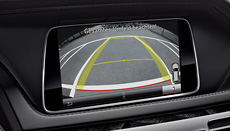
| |
Active Lane Keeping Assist (optional)[4] The Lane Keeping Assist feature warns the driver by means of a discreet vibration of the steering wheel as soon as it detects that the lane markings that have been registered by the system are about to be crossed. If, prior to crossing the lane, the indicator had been actuated or the steering wheel firmly turned, the system assumes that the lane change is intentional and does not react. | |
Blind Spot Assist (optional)[4] Blind Spot Assist uses two radar sensors in the rear bumper to monitor the blind spot at speeds above 30 km/h and can warn the driver against dangerous lane changes if the system detects another road user in the critical area to the right or left of the vehicle. | |
Traffic Sign Assist (optional)[5] The expanded system builds upon the previous Speed Limit Assist. Traffic signs are identified visually by a camera system behind the windscreen.
In addition to the traffic signs already recognised by the system previously, the function was now expanded to also include the recognition of 'Do not enter' and 'No passing' signs as well as of the signs lifting the restrictions. The system compares the detected traffic signs with the traffic signs stored in its memory and shows them on the display if a match is found. In addition to the plausibility check against the signs stored in the system, the system also uses data from the navigation system.
| |